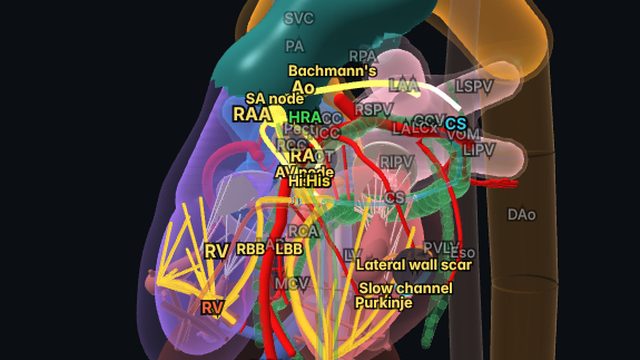
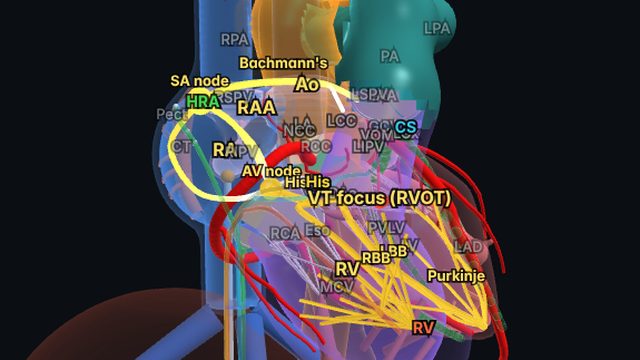
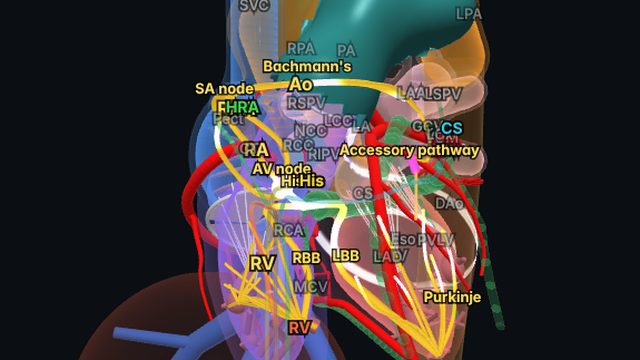
 Total Heart Sim

What it is
In ventricular fibrillation (VF), multiple wavelets activate the ventricles chaotically, so there is no coordinated contraction and no cardiac output. It is a leading cause of sudden cardiac death and may follow ischaemia, scar-related VT, pre-excited AF or inherited arrhythmia syndromes.
On the ECG
An irregular, chaotic waveform with no identifiable QRS complexes, varying in amplitude (coarse or fine). Sinus P waves may continue but are unseen.
Treatment
Immediate defibrillation and cardiopulmonary resuscitation. Survivors without a reversible cause generally receive an ICD for secondary prevention.
Frequently asked questions
What is the difference between VT and VF?
VT is organized: regular, repeating QRS complexes from a focus or circuit, often with some cardiac output. VF is disorganized, with no QRS complexes and no output; it needs immediate defibrillation.
References
- Al-Khatib SM, et al. 2017 AHA/ACC/HRS guideline for management of patients with ventricular arrhythmias and the prevention of sudden cardiac death. Circulation. 2018;138:e272–e391.
- Zeppenfeld K, et al. 2022 ESC guidelines for the management of patients with ventricular arrhythmias and the prevention of sudden cardiac death. Eur Heart J. 2022;43:3997–4126.
Educational content for clinicians and trainees; not medical advice. The simulator's rhythms are simplified models for teaching.