 Total Heart Sim
What it is
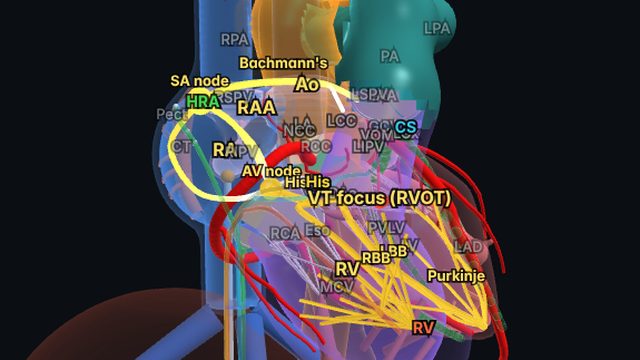
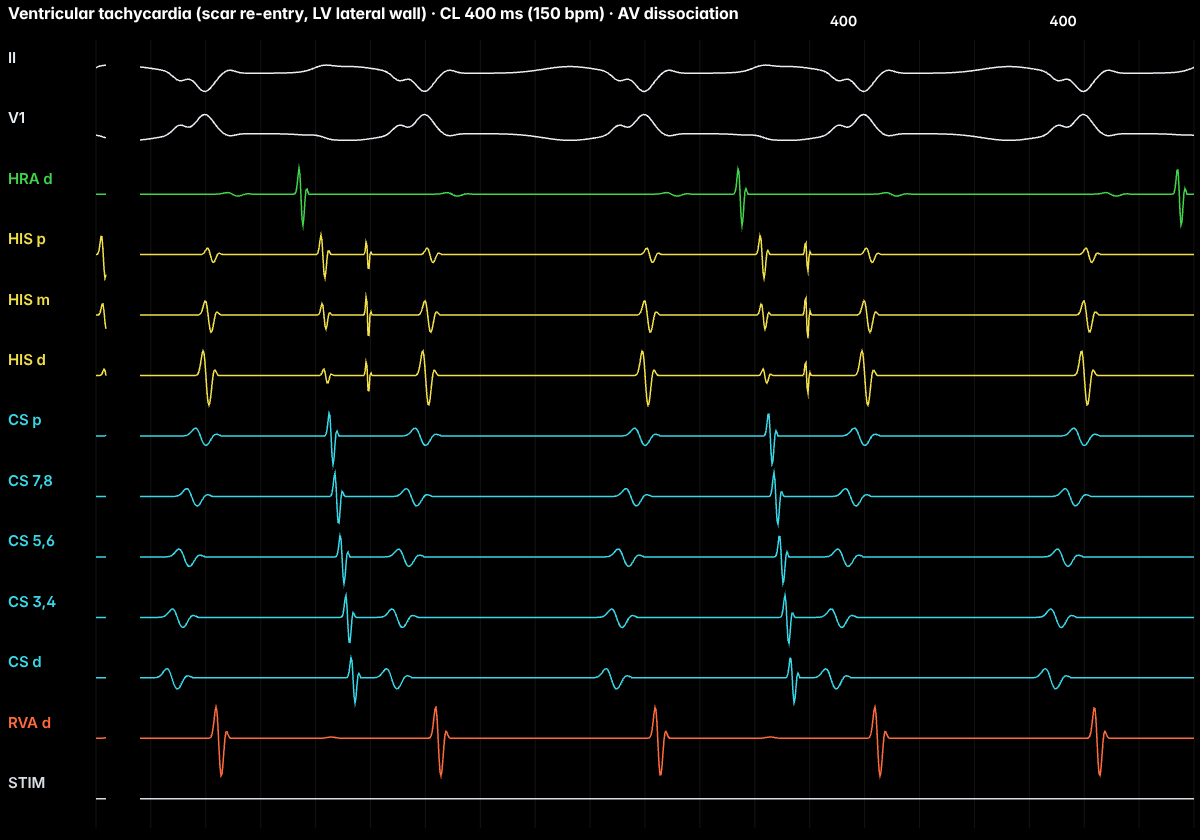
After a myocardial infarction, surviving bundles of muscle run through the scar. These channels conduct slowly, and when activation enters one, exits into healthy myocardium and returns around the scar, it forms a re-entrant circuit: sustained monomorphic VT.
On the ECG
A regular wide-QRS tachycardia. The QRS shape reflects where the circuit exits the scar; VT from the LV free wall usually has a right bundle branch block–like pattern in V1. AV dissociation, fusion beats and capture beats are diagnostic of VT.
In the EP lab
Programmed ventricular stimulation (a drive train followed by one to three extrastimuli) induces it. Entrainment mapping identifies the critical isthmus (concealed entrainment with PPI − TCL close to zero), and substrate mapping in sinus rhythm targets abnormal, late and fractionated potentials.
Treatment
An implantable cardioverter-defibrillator is indicated for most patients with sustained VT and structural heart disease. Antitachycardia pacing (ATP) can terminate many episodes painlessly. Catheter ablation reduces recurrences and is used for recurrent VT despite drugs, and earlier in selected patients.
Frequently asked questions
What is antitachycardia pacing (ATP)?
A short burst of ventricular pacing slightly faster than the VT. Paced wavefronts enter the circuit, collide with the circulating wavefront and terminate it, without a shock. ICDs deliver ATP automatically for many re-entrant VTs.
References
- Al-Khatib SM, et al. 2017 AHA/ACC/HRS guideline for management of patients with ventricular arrhythmias and the prevention of sudden cardiac death. Circulation. 2018;138:e272–e391.
- Zeppenfeld K, et al. 2022 ESC guidelines for the management of patients with ventricular arrhythmias and the prevention of sudden cardiac death. Eur Heart J. 2022;43:3997–4126.
- Josephson's Clinical Cardiac Electrophysiology: Techniques and Interpretations. Wolters Kluwer.
Educational content for clinicians and trainees; not medical advice. The simulator's rhythms are simplified models for teaching.