 Total Heart Sim
What it is
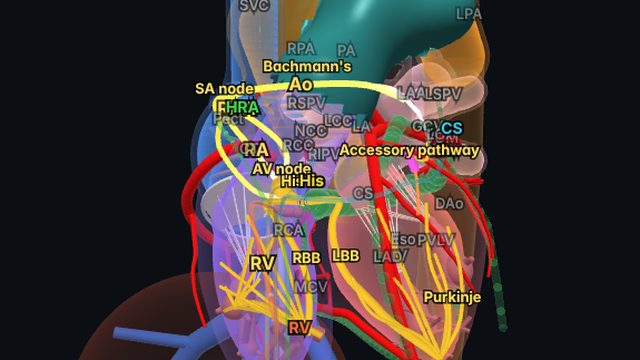
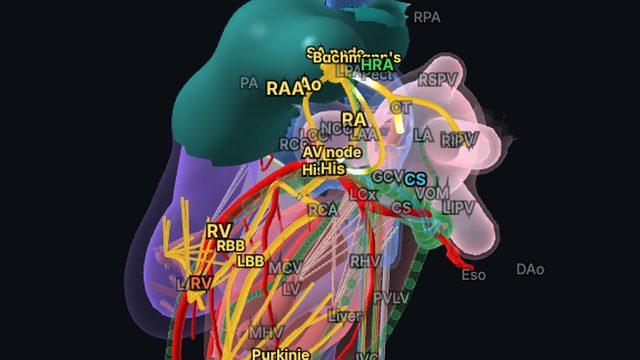
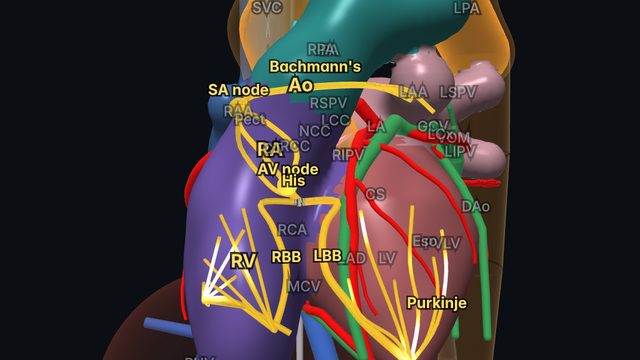
When atrial fibrillation occurs in someone with a manifest accessory pathway, the chaotic atrial impulses can bypass the rate-limiting AV node and reach the ventricles through the pathway. If the pathway has a short refractory period, ventricular rates can be extremely fast and the rhythm can degenerate into ventricular fibrillation.
On the ECG
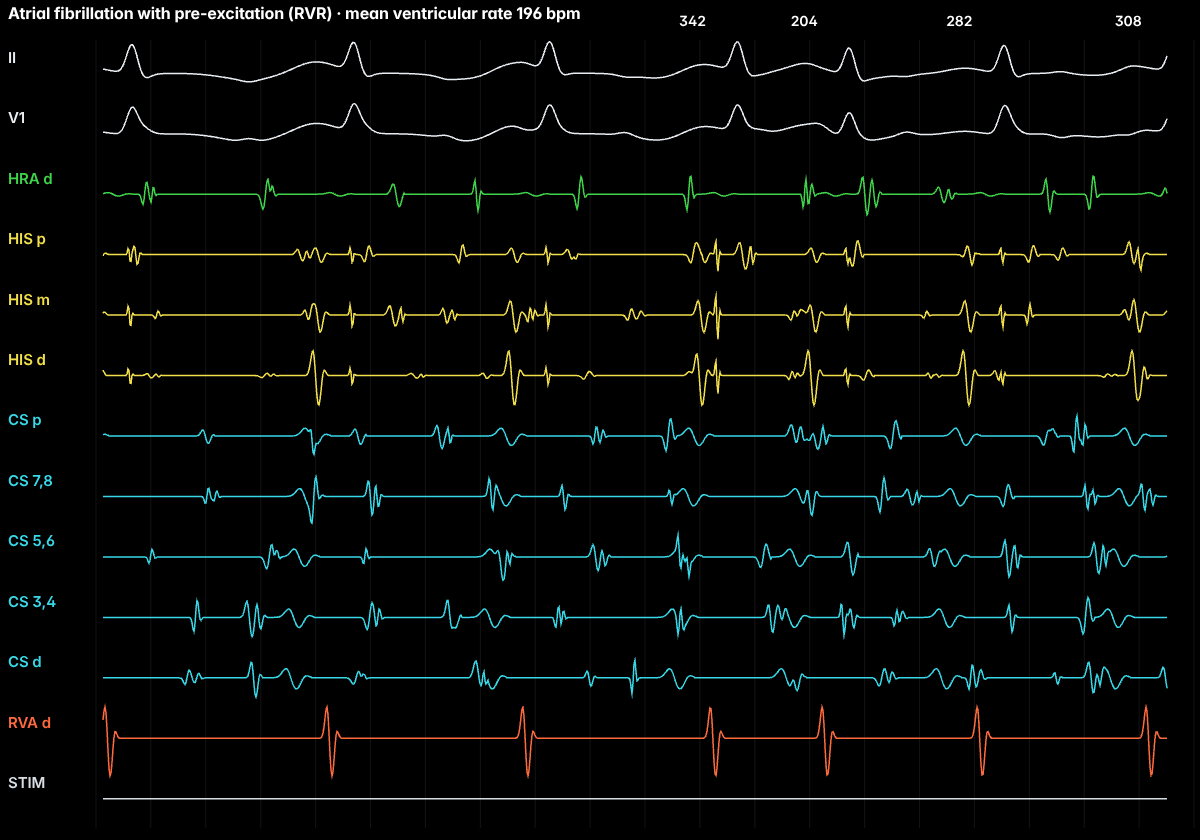
Fast, broad and irregular ("FBI"): an irregularly irregular wide-QRS tachycardia in which the QRS shape changes from beat to beat as the share of activation through the pathway and the AV node varies. Very short pre-excited RR intervals (under 250 ms) mark a high-risk pathway.
Treatment
Unstable patients need immediate synchronized cardioversion. In stable patients guidelines recommend intravenous procainamide or ibutilide, and warn that AV-nodal blocking drugs such as adenosine, verapamil, diltiazem and digoxin, and intravenous amiodarone, are potentially harmful because blocking the node can increase conduction down the pathway. Catheter ablation of the pathway follows.
Frequently asked questions
Why are AV-nodal blockers contraindicated in pre-excited AF?
They slow or block the AV node but not the accessory pathway, so more impulses can conduct down the pathway, the ventricular rate can rise and the rhythm can degenerate into VF. Procainamide, ibutilide or cardioversion are used instead.
References
- Page RL, et al. 2015 ACC/AHA/HRS guideline for the management of adult patients with supraventricular tachycardia. Circulation. 2016;133:e506–e574.
- Joglar JA, et al. 2023 ACC/AHA/ACCP/HRS guideline for the diagnosis and management of atrial fibrillation. Circulation. 2024;149:e1–e156.
- Brugada J, et al. 2019 ESC guidelines for the management of patients with supraventricular tachycardia. Eur Heart J. 2020;41:655–720.
Educational content for clinicians and trainees; not medical advice. The simulator's rhythms are simplified models for teaching.