 Total Heart Sim
What it is
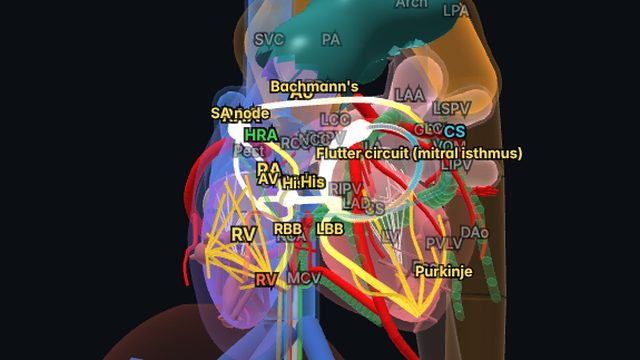
The ligament of Marshall carries the vein of Marshall and muscle bundles that connect the coronary sinus musculature with the left atrium near the left pulmonary veins and mitral isthmus. These epicardial connections can form part of re-entrant atrial tachycardias, particularly after AF ablation.
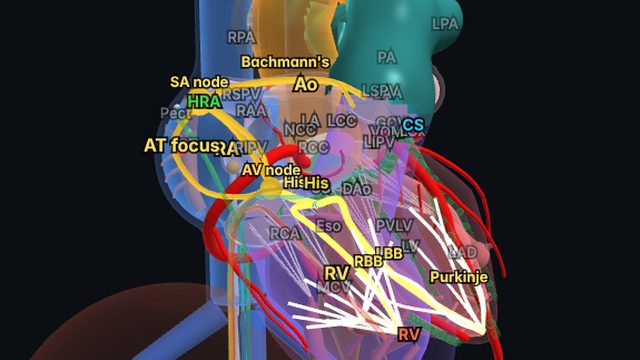
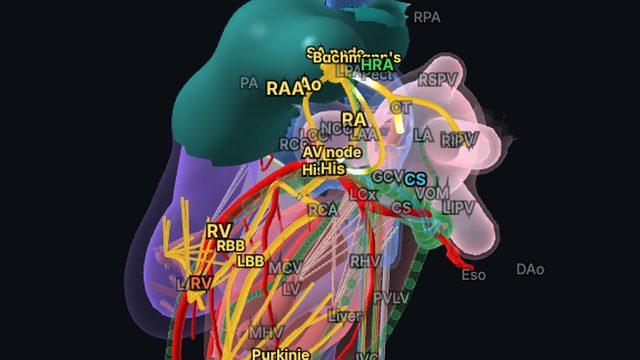
In the simulator model, the circuit conducts slowly along the posterior mitral isthmus, exits into the Marshall bundle, runs down the vein of Marshall into the coronary sinus and returns to the mitral vestibule.
On the ECG and in the EP lab
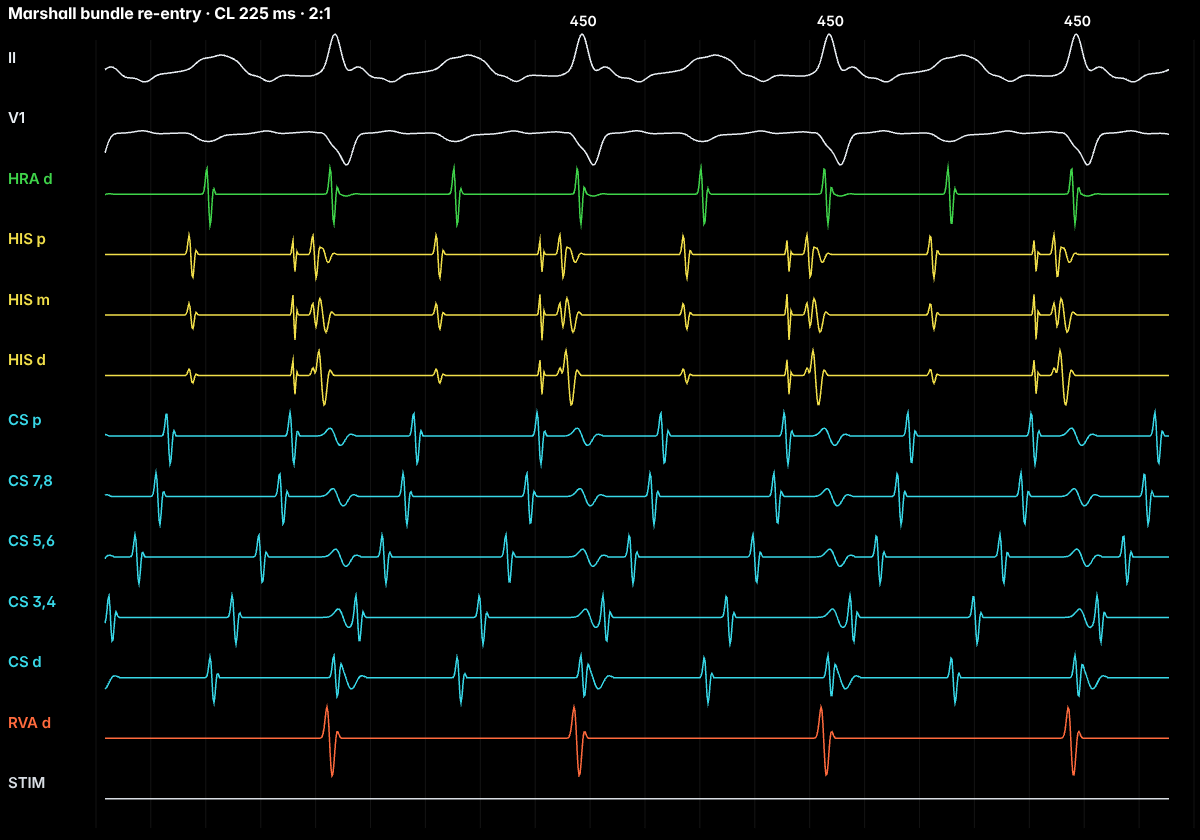
Because the rest of the atria activate outward from a single exit, it looks like a focal atrial tachycardia: discrete P waves and centrifugal activation with the earliest site near the CS and lateral mitral annulus. Entrainment shows PPI − TCL close to zero near the isthmus, revealing re-entry.
Treatment and ablation
Options include a posterior mitral isthmus line at the valve, ablation within the coronary sinus, and ethanol infusion into the vein of Marshall.
Frequently asked questions
Why does Marshall bundle re-entry look focal?
The circuit is small and mostly epicardial, so the endocardium is activated outward from one exit point, just as it would be from a focus. Entrainment mapping shows that sites near the isthmus are in the circuit.
References
- Joglar JA, et al. 2023 ACC/AHA/ACCP/HRS guideline for the diagnosis and management of atrial fibrillation. Circulation. 2024;149:e1–e156.
- Issa ZF, Miller JM, Zipes DP. Clinical Arrhythmology and Electrophysiology: A Companion to Braunwald’s Heart Disease. Elsevier.
Educational content for clinicians and trainees; not medical advice. The simulator's rhythms are simplified models for teaching.