 Total Heart Sim
What it is
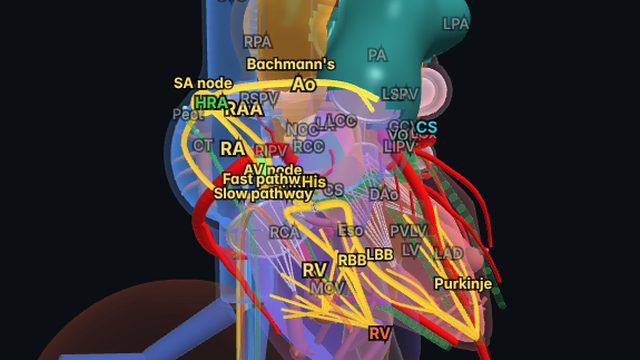
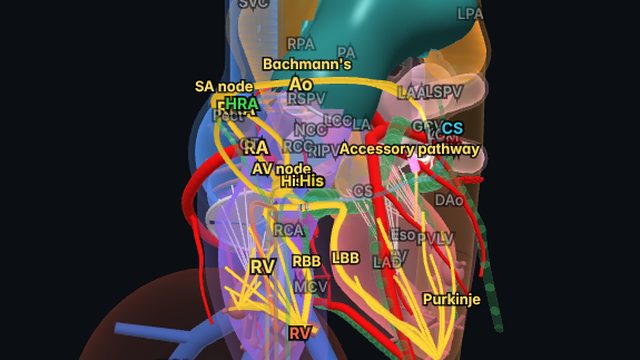
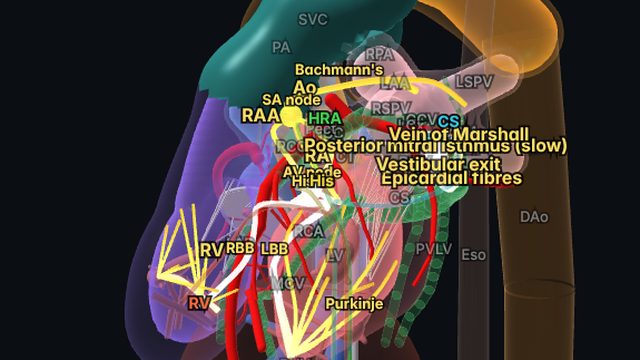
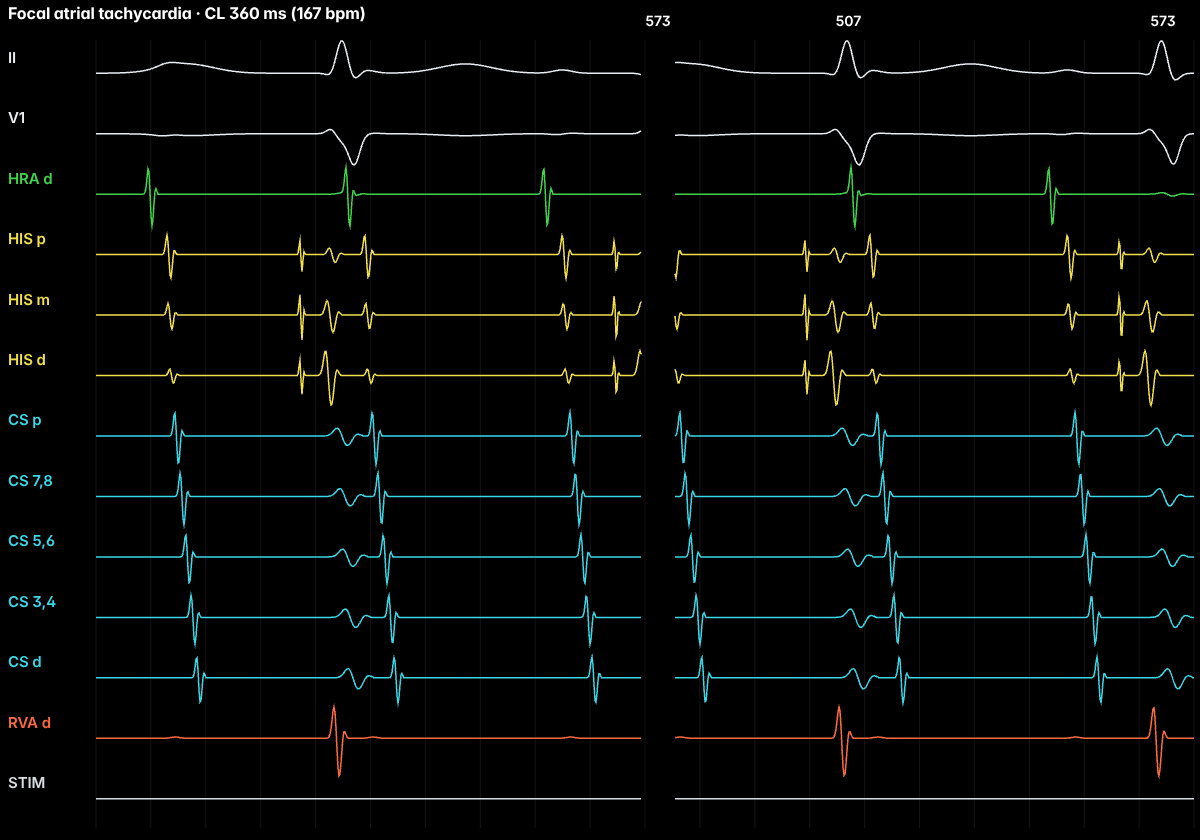
Focal atrial tachycardia arises from a small area of atrial tissue (automatic, triggered or micro-re-entrant) and spreads outward from there. In the right atrium the crista terminalis is the commonest site; others include the tricuspid and mitral annuli, the coronary sinus ostium and the pulmonary veins.
On the ECG
Discrete P waves with an isoelectric baseline between them, at a rate faster than sinus. The P-wave shape depends on the focus; a high crista focus can look much like sinus rhythm. If the AV node cannot follow every beat, conduction becomes Wenckebach or 2:1: the tachycardia continues through AV block, which rules out AVRT and makes AVNRT unlikely.
With 1:1 conduction and a long PR, each P wave can land just after the previous QRS and mimic the short-RP pattern of orthodromic AVRT.
In the EP lab
Atrial activation spreads from the focus, so a crista focus activates the high right atrium first (high-to-low), not the septum or distal coronary sinus. The apparent VA interval is coincidental and changes with the AV conduction time.
Ventricular overdrive pacing with 1:1 VA conduction gives a V-A-A-V response on stopping, which separates atrial tachycardia from AVNRT and AVRT (V-A-V). Atrial entrainment from several sites shows the shortest PPI − TCL nearest the focus.
Anatomy and ICE
The crista terminalis is a muscular ridge between the smooth and trabeculated right atrium; it is well seen on intracardiac echo, which helps place the catheter on a crista focus and avoid the phrenic nerve and sinus node region.
Treatment and ablation
Some focal tachycardias terminate with adenosine; others show only transient AV block. Beta-blockers or calcium-channel blockers can control rate, and catheter ablation at the site of earliest activation is the definitive treatment for recurrent or incessant cases.
Frequently asked questions
What is the V-A-A-V response?
After ventricular overdrive pacing with 1:1 VA conduction stops, the last paced ventricular beat is followed by two atrial activations before the next ventricular beat. It points to atrial tachycardia rather than AVNRT or AVRT, which give V-A-V (with caveats for atypical AVNRT).
Why does AV block help the diagnosis?
A tachycardia that continues with AV block cannot be orthodromic AVRT, because that circuit needs the ventricles. Persisting atrial tachycardia during block favours atrial tachycardia (or, less commonly, AVNRT with lower common pathway block).
References
- Page RL, et al. 2015 ACC/AHA/HRS guideline for the management of adult patients with supraventricular tachycardia. Circulation. 2016;133:e506–e574.
- Brugada J, et al. 2019 ESC guidelines for the management of patients with supraventricular tachycardia. Eur Heart J. 2020;41:655–720.
- Issa ZF, Miller JM, Zipes DP. Clinical Arrhythmology and Electrophysiology: A Companion to Braunwald’s Heart Disease. Elsevier.
Educational content for clinicians and trainees; not medical advice. The simulator's rhythms are simplified models for teaching.