 Total Heart Sim
What it is
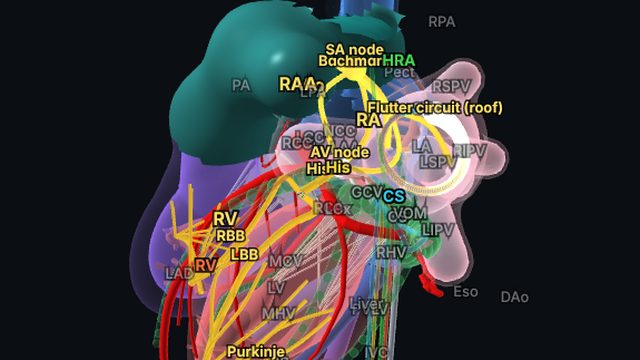
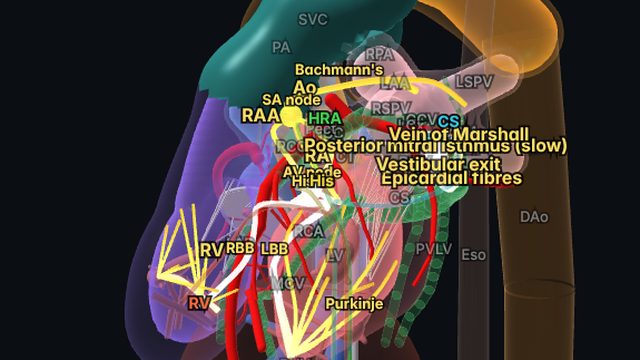
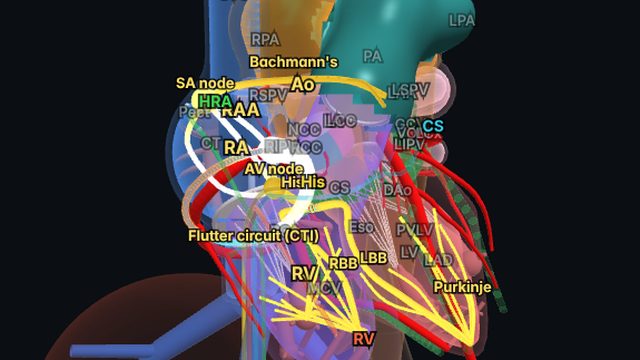
Peri-mitral flutter is a macro-re-entrant circuit around the mitral annulus in the left atrium. It is typical after AF ablation, mitral valve surgery or in atria with scarring. The critical link is often the mitral isthmus, between the lateral mitral annulus and the left inferior pulmonary vein.
On the ECG and in the EP lab
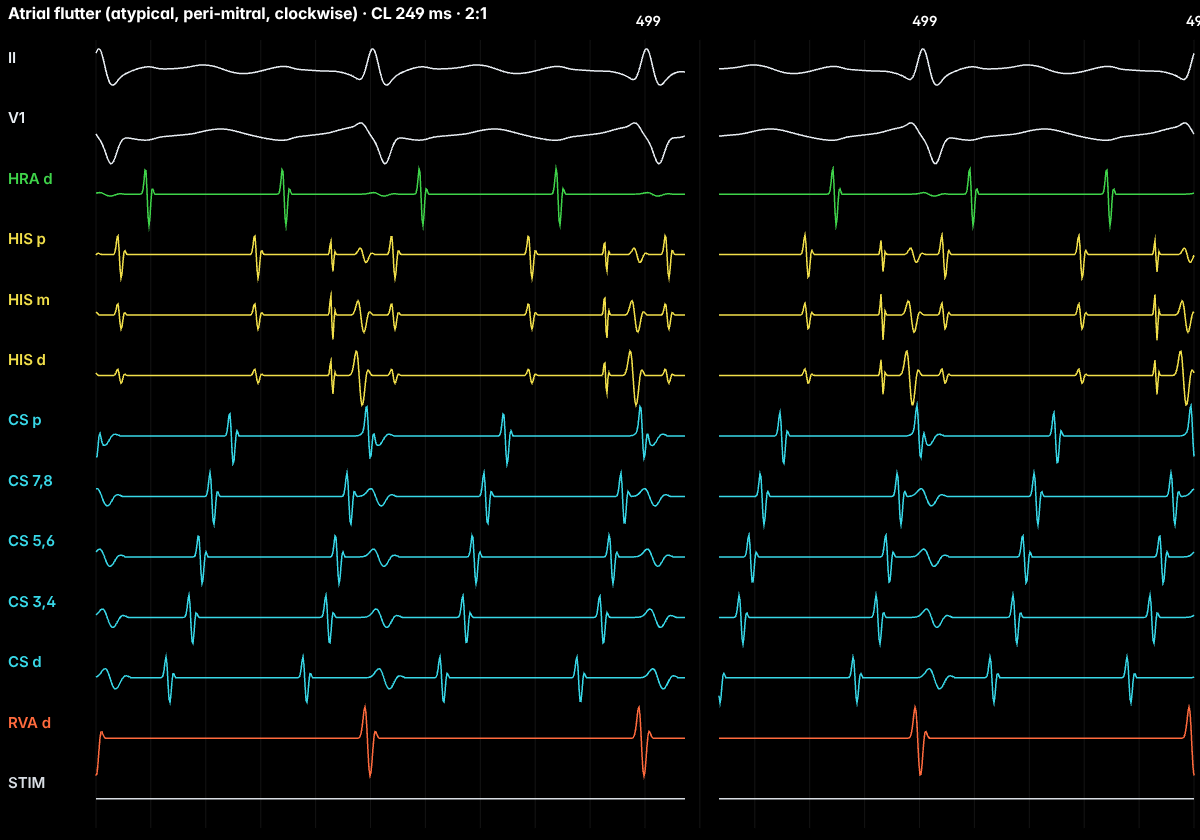
Flutter waves are often upright or low amplitude rather than classically sawtooth. The coronary sinus, lying along the mitral annulus, reports the direction: counter-clockwise flutter (viewed in LAO) activates the CS proximal to distal, clockwise flutter distal to proximal. Entrainment from the lateral mitral annulus and from opposite sides of the annulus gives PPI − TCL close to zero.
Anatomy and ICE
The mitral isthmus has epicardial muscle along the coronary sinus and the vein of Marshall, which is why endocardial lines often need ablation inside the CS, or ethanol in the vein of Marshall, to achieve block.
Treatment and ablation
Ablation aims at a line that blocks the circuit: a lateral mitral isthmus line from the annulus to the left inferior pulmonary vein or an anterior line, checked for block with differential pacing.
Frequently asked questions
How do you tell clockwise from counter-clockwise peri-mitral flutter?
From the CS activation sequence: counter-clockwise flutter (viewed in LAO) activates the CS from proximal to distal, clockwise flutter from distal to proximal. Entrainment confirms the circuit.
References
- Joglar JA, et al. 2023 ACC/AHA/ACCP/HRS guideline for the diagnosis and management of atrial fibrillation. Circulation. 2024;149:e1–e156.
- Brugada J, et al. 2019 ESC guidelines for the management of patients with supraventricular tachycardia. Eur Heart J. 2020;41:655–720.
- Issa ZF, Miller JM, Zipes DP. Clinical Arrhythmology and Electrophysiology: A Companion to Braunwald’s Heart Disease. Elsevier.
Educational content for clinicians and trainees; not medical advice. The simulator's rhythms are simplified models for teaching.