 Total Heart Sim
What it is
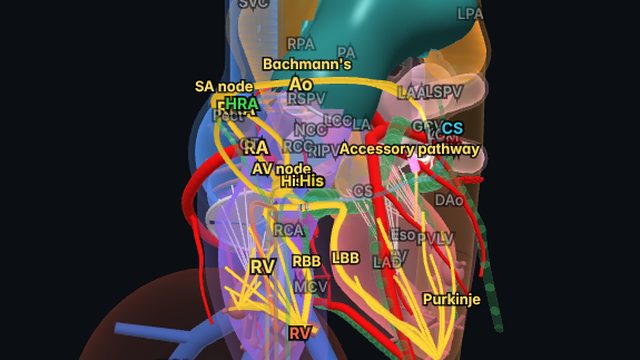
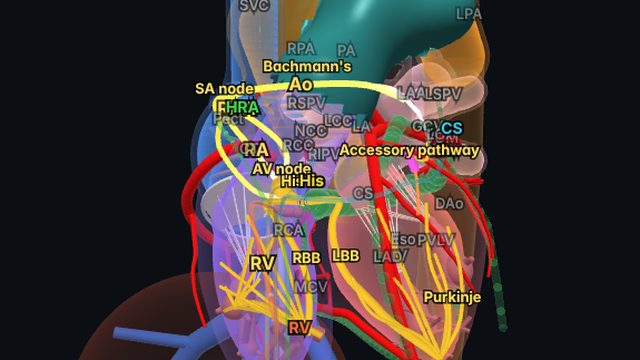
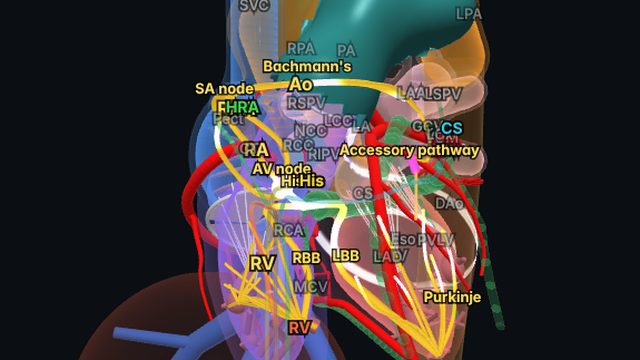
In antidromic AVRT the circuit runs the opposite way to orthodromic AVRT: down the accessory pathway to the ventricles and back up the His–Purkinje system and AV node (or a second pathway). It is the less common form of AVRT.
On the ECG
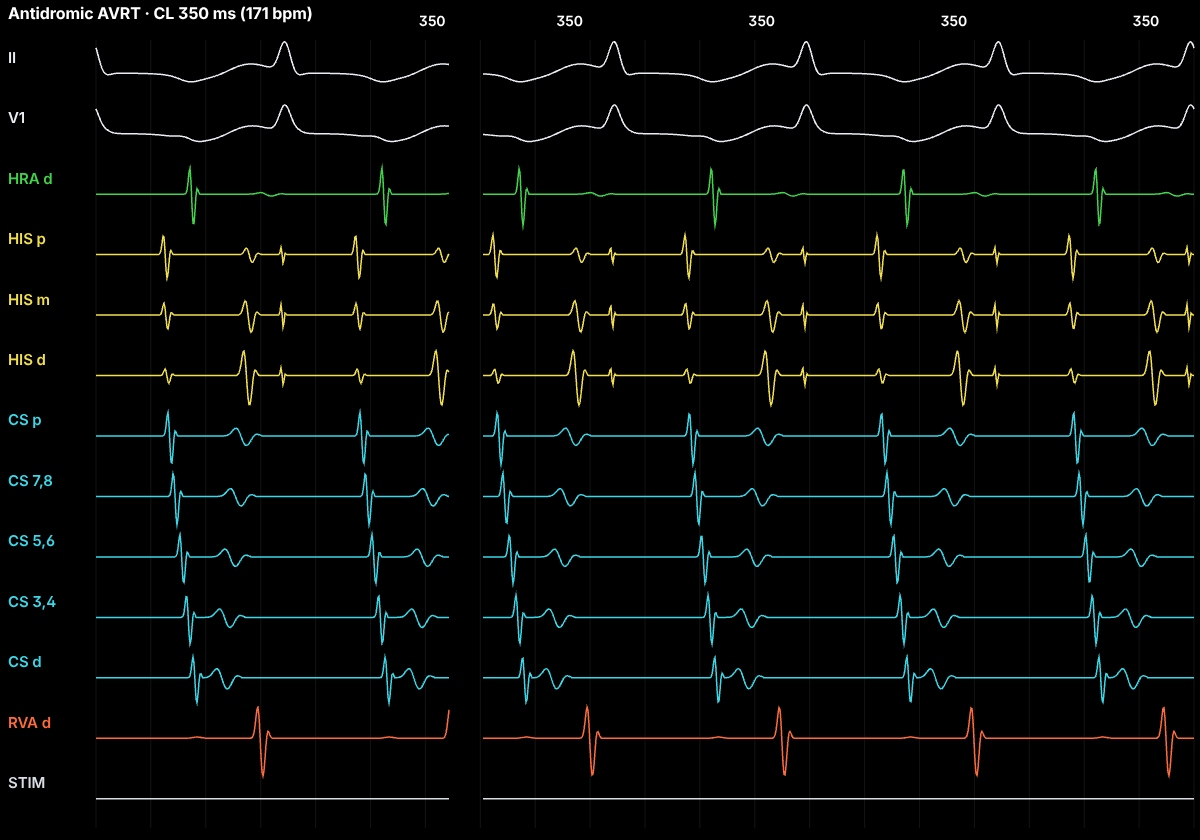
A regular wide-QRS tachycardia in which every QRS is fully pre-excited, so it closely resembles ventricular tachycardia. Retrograde P waves, when seen, come late after the QRS.
In the EP lab
Ventricular activation starts at the pathway insertion (for a left lateral pathway, the lateral mitral annulus), and the His is activated retrogradely, after the ventricle. Atrial pacing that pre-excites the ventricle at the same timing and morphology supports the diagnosis.
Treatment and ablation
Because a wide, pre-excited tachycardia can be hard to tell from VT or pre-excited AF, AV-nodal blockers are generally avoided; procainamide or synchronized cardioversion are used acutely. Ablating the pathway is the definitive treatment.
Frequently asked questions
How is antidromic AVRT distinguished from VT?
Both are regular wide-QRS tachycardias. Clues to antidromic AVRT include a known manifest pathway, a QRS identical to maximal pre-excitation in sinus rhythm or with atrial pacing, and 1:1 VA relationship; AV dissociation strongly favours VT. When in doubt, it is treated as VT.
References
- Page RL, et al. 2015 ACC/AHA/HRS guideline for the management of adult patients with supraventricular tachycardia. Circulation. 2016;133:e506–e574.
- Brugada J, et al. 2019 ESC guidelines for the management of patients with supraventricular tachycardia. Eur Heart J. 2020;41:655–720.
- Josephson's Clinical Cardiac Electrophysiology: Techniques and Interpretations. Wolters Kluwer.
Educational content for clinicians and trainees; not medical advice. The simulator's rhythms are simplified models for teaching.